Hello, My Name is Beriah Magoffin: Petition Writing in Civil War Kentucky
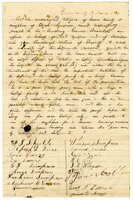
Names hold power. They recall memories of previous generations and ancestors lost to time. They also can invoke the legacies of war heroes, call upon partisan passions, or link to the celebrity of national figures. In short names can be a versatile tool to connect individuals to family members or social and political leaders. Names can also be used as a window to provide Civil War Governors of Kentucky (CWGK) users with insight into how Kentuckians petitioned the Commonwealth’s wartime governors for a redress of their grievances between 1861 and 1865. Take for instance the petition of James Taulbee, Sr., fined for a brawl in Wolfe County in late 1860.
In January 1861, Taulbee was sixty-six years old, a veteran of the War of 1812, and a farmer with a growing family. William Spencer, a judge in Wolfe County had fined Taulbee for a brawl with another man named Kidd. Taulbee argued that he had struck Kidd in self-defense after he had twice thrown “your old friend against the Door of a house.”[1] On several instances in his letter to the Governor, Taulbee cited a personal relationship between the two men. He had opened with the phrase “your Old & true friend.” In addition to personal connections, Taulbee wove a tale of woe. Three years earlier, Taulbee’s first wife, Elizabeth, had died. The farmer had since remarried. His family now included nine children from his first marriage and three more from his second marriage. This added a burden to the Taulbee household. Time had also chipped away at the farmer. Once powerfully strong, nature was “fast wearing me away & I am poor & if said fine is collected off of me I fear it ^will^ stint my twins & prevent them from growing up ^large^ and making good soldiers for I design my children to be soldiers.”[2]
Those twins were a lynchpin in Taulbee’s personal appeal. After having a first son (Samuel) with his second wife, also named Elizabeth, Taulbee fed her ram’s meat. He credited that intervention with the birth of healthy twins almost two years later. To cement the personal appeal of friendship, Taulbee shared that he had named one of them Beriah Magoffin Taulbee. A circuit judge from Morgan County, William H. Burns, supported Taulbee’s petition, testifying to the accuracy of his claims. For whatever reason—the claims of friendship and poverty, Burns’s support, or the name of one twin—Magoffin remitted the five dollars fine against Taulbee. There was only one small problem: Taulbee lied. There was no Beriah or Magoffin in his household—the twins were named Greenville and Granville, likely a connection to Taulbee’s North Carolina roots, not his old friend in Frankfort.[3]
The lie, as well as the dubious claim that ram’s meat made healthy twins, might make Taulbee’s petition humorous, but it reveals deeper commonalities between his petition and the hundreds of others that exist throughout CWGK. The first place to start is with the uncertainty behind why Magoffin remitted the fine. Magoffin could have been motivated by a previous personal relationship, Taulbee’s claims to poverty, or the false assumption that Taulbee named one of his children after the governor. However, the truth matters little here—the fact that Taulbee had even bothered to concoct such a story begs questions about the nature of petition writing and pardon granting in Kentucky. Historian Robert Ireland wrote that Kentucky governors in the middle of the nineteenth century were cavalier with their pardoning powers. Without a systematic set of principles or regulations to guide their ability to pardon fines and crimes, one of their chief political tools, Kentucky governors applied that power liberally. Ireland went as far as to suggest that noted criminals and hooligans laughed their way out of court, as they knew with one letter, their fines or punishments would be stripped away.[4]
Historians know preciously little about how mid-nineteenth century Kentuckians (or mid-century Americans more broadly) constructed their petitions. Petitions to officials have served as important vehicles for studies on loyalty, conscription, and the social impact of the war on ordinary people.[5] In other studies, such as a recent report by Maggie Blackhawk, Daniel Carpenter, Tobias Resch, and Benjamin Schneer, highlights the creation of a new dataset on petitions American citizens wrote to Congressional leaders between 1789 and 1949. For 160 years, petitions connected Americans to their representatives while they simultaneously shaped political agendas and legislative dockets.[6] As CWGK, its sister project in Mississippi (The Civil War and Reconstruction Governors of Mississippi), and other historians have noted, wartime Americans petitioned local, state, and national leaders on a great variety of issues that mattered to them during and after the war.
Taulbee’s claims of poverty and fear of financial distress connect to an endemic trend in CWGK’s petitions. Numerous petitions across the edition cite fears of financial ruin brought on by the various fines imposed by Kentucky courts. Residents of Green County pleaded with Gov. Thomas E. Bramlette, that Elijah Sympson was “a poor (very poor) man. with a large & helpless family.”[7] Samuel Geisler, an attorney from Newport, Kentucky, wrote Gov. James F. Robinson that Constantin Riendenger, was poor man fined for selling liquor to a minor.[8] Other examples, from across the Commonwealth, constantly cited poverty and economic hardship—be it poor mothers, ailing children or widowed spouses. The phrase “poor man” appears in more than seven hundred of CWGK’s original ten thousand documents. Put another way, roughly seven percent of those documents highlight the potential adverse economic consequences of a fine as a reason for leniency or remission of the sentence. The Civil War certainly had a destructive impact on many Kentuckians—from the occupation of either army, the emancipation of enslaved Kentuckians, a drought in the summer of 1862, and constant irregular warfare. Without question, some of these requests for intervention from Frankfort on behalf of Kentuckians were motivated by financial distress, but Taulbee’s lack of truthfulness and the similar pleas of poverty across petitions strike a curious and skeptical note.
To return us to the power of names, Taulbee’s mythic Beriah Magoffin would fit into another pattern in Kentucky and wider nineteenth century American. CWGK is filled with numerous examples of individuals with names that echoed the legacies of early American heroes. For example, George Washington Williams, was an attorney, state legislator, and enslaver from Hancock County. Thomas Jefferson Hardin was a merchant from Owen County who served in the Union Army from the summer of 1862 to April 1865. The editor of the Frankfort Commonwealth, Albert Gallatin Hodges, was named after another Founding Father, Abraham Alfonse Albert Gallatin (more commonly known as Albert Gallatin). Williams, Hardin, and Hodges, are just a handful of examples of people who shared the names of some illustrious Americans who preceded them. For context, CWGK has identified thirty-five other George Washingtons, sixteen Thomas Jeffersons, fourteen Benjamin Franklins, twenty-three Andrew Jacksons and fourteen Henry Clays—to name just a few.
Nineteenth century Americans had access to a range of instruction manuals that ranged from social etiquette to detecting forged bank notes.[9] Yet the frequency of the appeals as well as the support of professionals, like attorneys Samuel Geisler and William H. Burns, who often wrote on behalf of or drafted petitions themselves, speaks to a broader pattern across the state. For CWGK, that pattern and Taulbee’s letter invite deeper analysis of the letters and petitions written to Frankfort during the war. Not just to look at the social elements behind the men and women that appear through the edition (such as the lack of a Beriah Magoffin Taulbee in the Taulbee household), but also to ponder the construction of mid-nineteenth century petitions.
There is not a clear answer to why Magoffin remitted Taulbee’s fine or why the Owsley County farmer lied about the name of his children. What Taulbee encourages the staff of CWGK and visitors to the project, to think about obliquely is how these individuals pulled their petitions together. CWGK is a treasure-trove of personal stories, hardships, and lies. Yet, it can also yield deeper questions about the ways in which Kentuckians understood their world and interacted with officials in Frankfort.
Footnotes
- ^ Taulbee appears in the Federal Censuses of 1850 and 1860 as a farmer from North Carolina, born around 1795. In his appeal to Magoffin, Taulbee notes that he is sixty-six years old. Seventh Manuscript Census of the United States (1850), Population Schedules, Kentucky, Owsley County, p. 290B; Eighth Manuscript Census of the United States (1860), Population Schedules, Kentucky, Owsley County, p. 422. James Taulbee, Sr. to Beriah Magoffin, January 22, 1861, Office of the Governor, Beriah Magoffin: Governor's Official Correspondence File, Petitions for Pardons and Remissions, 1859–1862, MG18-364 to MG18-365, Kentucky Department for Libraries and Archives, Frankfort, Ky, accessed via the Civil War Governors of Kentucky Digital Documentary Edition, https://discovery.civilwargovernors.org/document/KYR-0001-020-0556 (hereafter KDLA, CWGK, URL).
- ^ James Taulbee, Sr. to Beriah Magoffin, January 22, 1861. “Taulbee, James,” War of 1812 Pension and Bounty Land Warrant Application Files, RG 15, Microfilm Series T288, Pension #34904, National Archives and Records Administration Washington, D. C. (hereafter NARA).
- ^ Eighth Manuscript Census of the United States (1860), Population Schedules, Kentucky, Owsley County, p. 422. Granville Taulbee also appears one of the claimants for Taulbee’s War of 1812 pension, filed in early 1911, “Taulbee, James,” War of 1812 Pension and Bounty Land Warrant Application Files, NARA RG 15, Microfilm Series T288, Pension #34904.
- ^ Robert M. Ireland, “Law and Disorder in Nineteenth-Century Kentucky,” Vanderbilt Law Review, Symposia: The Legal History of the South, 32, no. 1 (1979), 281-99.
- ^ See for example: William Blair, Virginia's Private War: Feeding Body and Soul in the Confederacy, 1861-1865 (University of North Carolina Press, 1998); John M. Sacher, Confederate Conscription and the Struggle for Southern Soldiers (Louisiana State University Press, 2021); Amy E. Murrell (Taylor) ), “‘Of Necessity and Public and Benefit’”: Southern Families and Their Appeals for Protection," in Southern Families at War: Loyalty and Conflict in the Civil War South, ed. Catherine Clinton (Oxford University Press, 2000), 77–100.
- ^ Maggie Blackhawk, Daniel Carpenter, Tobias Resch, and Benjamin Schneer. The Contours of American Congressional Petitioning, 1789-1949: A New Database. 2020. https://dcarpenter.scholars.harvard.edu/publications/effect-published-medical-research-upon-media-attention-disease-twenty-year
- ^ F. L. Shields et al. to Thomas E. Bramlette, March 1864 Office of the Governor, Thomas E. Bramlette: Govenor’s official correspondence file, petitions for pardons, remissions, and respites 1863–1867, BR9-388 to BR-389, KDLA, CWGK, https://discovery.civilwargovernors.org/document/KYR-0001-004-0560.
- ^ Samuel Geisler to James F. Robinson, November 9, 1862, Office of the Governor, James F. Robinson: Governor's official correspondence file, petitions for pardons, remissions, and respites, 1862–1863, R3-182 to R3-183, KDLA, CWGK, https://discovery.civilwargovernors.org/document/KYR-0001-029-0117.
- ^ See: Karen Halttunen, Confidence Men and Painted Women: A Study of Middle-class Culture in America, 1830-1870 (Yale University Press, 1986) and Stephen Mihm, A Nation of Counterfeiters: Capitalists, Con Men, and the Making of the United States (Harvard University Press, 2007).