“Old Friends, Private and Political:” Political Parties in the Civil War Governors Papers
Political party affiliation formed a core part of white American identity in the mid-nineteenth century. During the various local, state, and national elections occurring throughout the year, even the most mundane items took on a partisan significance: buttons, ribbons, newspapers, and even a specific tree, could be used to indicate one’s political preferences.[1] The Civil War, however, presented a new political reality. The Bluegrass State had been an active player in the party conflicts of the 1830s, 1840s, and 1850s, with luminaries such as Henry Clay leading the opposition to Andrew Jackson’s Democratic Party on issues such as banking, tariffs, and funding infrastructure projects. When slavery overtook most other considerations in the 1850s, Kentucky used its unique position between North and South to offer a conservative middle ground in hopes of staving off sectional conflict. With these hopes dashed, Kentuckians turned to old party conflicts in attempting to understand their place within the world of the Civil War.
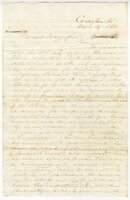
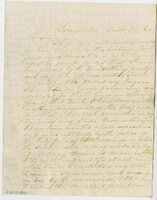
Kentuckians carried their partisan identities and interactions into the war years as they interacted with the state government, especially the governor’s office. The aging sheriff Vincent Taylor described himself to Governor Thomas Bramlette as an “old friend privet & Political” before asking the executive to release a son from military service (KYR-0001-003-0005).[2] An unknown writer was more explicit when he wrote to a different Kentucky governor, Beriah Magoffin. The anonymous correspondent reminded Magoffin of their initial meeting, “when I first saw you, in a democratic Convention more than Twenty long years ago.” Not only the occasion, but Magoffin himself, made an impression on the letter-writer, “you made a democratic speech in a large Blanket coat” (KYR-0001-020-1740).[3] Party ties clearly mattered. These affinities were sincere and deeply held, and correspondents’ letters to the governor allowed them to maintain relationships with those in power as part of what Kristen Bailey calls “the performance of loyalty.”[4]
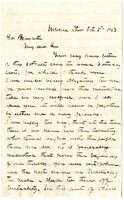
Kentuckians called on old political ties, even the memory of those parties that no longer functioned in the state, to aid them. Vincent Taylor’s mention of shared political beliefs strongly suggested that just like Bramlette, Taylor had once been a member of the long-gone Whig Party. While the Whig name might be unfamiliar to many twenty-first century Americans, this political party was the main competitor to the Democratic Party in the 1830s and 1840s. The Whigs, divided over the sectional questions of slavery, faltered as a national organization by 1852, ultimately expiring in 1856. Yet, a strong attachment to the party of native son Henry Clay, and its calls for preservation of the Union, persisted in Kentucky into the 1860s.[5] As Clay biographer and Kentucky historian James Klotter notes, “even if dead for over nine years, Clay lived on through his written words, remembered appeals, and learned behaviors,” allowing Kentuckians to call on the memories of their most famous politician during the war.[6] Describing Kentucky expatriates living in Ohio, General Edward P. Fyffe told Thomas Bramlette that “We were here always Henry Clay whigs, and continue whigs at heart” (KYR-0001-009-0009).[7]
These identities carried years of baggage and prejudices with them. While antebellum debates over banking, tariffs, or internal improvements no longer excited passionate argument, enough discontent remained between old Whigs and old Democrats to sustain conflict. One Louisville businessman complained to Governor Magoffin about unfair persecution in late 1860. He knew exactly who to blame: the old Whigs and Know-Nothings still haunting the River City. “I think I have been fleeced by the Knownothing party,” he explained. “I have been an uncompromising democrat for thirty years,” and “Since Know nothingism I have been hunted on all occasions and more especially by the police of the City for every little ordinance while the Same ordinance was violated by at most every Business man in the City with impunity” (KYR-0001-020-0277).[8] Echoing those concerns, a group of citizens from Bridgeport, Kentucky, led by J. Russell Hawkins begged Governor James Fisher Robinson not to remit the fine for John Blair. Blair, recently on the lam in Missouri, had illegally bet on a recent election. It was “all of one party, (the old Whig party)” who were responsible for the gambling, Hawkins explained, and taking the money proved “a more consummate skamp does not live than this same [John] H Blair” (KYR-0001-029-0453).[9]
Nor were Whigs and Know-Nothings the only targets of old feuds. Ohio General Edward P. Fyffe, complained to Governor Bramlette about his own long-standing grudge against Buckeye state Democrats. With animosity that dated back to 1849, Fyffe recalled how, “We offered to let the Democrats have the US Senator if they would give us the Supreme Judge, they at once agreed to it,” Fyffe explained, “but in that we were mistaken.” According to the general, Democrats violated the deal, filling both the Senate and the State Supreme Court, with Democrats, “giving us of the Whig party nothing.” Fyffe believed, as one of the Whigs involved, he had earned the ire of Secretary of the Treasury, Salmon P. Chase, the very same Democrat elected to the Senate fourteen years earlier (KYR-0001-009-0001).[10] By projecting onto Chase an inability to get over the old partisan past, Fyffe likewise demonstrated the persistence of old party loyalties.
Paradoxically, despite the depth of these political affiliations those identities were liable to change for mid-century Kentuckians. Recently, historians such as Rachel Shelden and Erik Alexander have argued that Americans were fluid with their political identities, far more than we have been led to believe.[11] Parties, they argue, were organic and dynamic with shifting membership profiles as people fluttered in and out over the course of their lives for reasons personal, political, or ideological. One need not look further than the Civil War governors of Kentucky themselves. While Beriah Magoffin remained a loyal Democrat throughout his life, his successors in office, James Fisher Robinson and Thomas Bramlette, started their political journeys as Whigs, but reinvented themselves as Democrats to remain politically relevant after the Civil War. James Wilson, a naturalized American citizen, admitted to Bramlette that throughout the 1850s “I was a Whig then and a Know Nothing (though a foreigner) then Anti Lecompton supporting Bell for President [in 1860].” In 1863, he finally supported Bramlette’s candidacy for governor as a Union War Democrat (KYR-0001-004-2289).[12] Wilson, Bramlette, and Robinson’s courses represented similar transitions by white Kentuckians during the Civil War Era.
The Civil War disrupted many aspects of Kentuckians’ self-identity. The Rebellion challenged their perspective as southerners as their neighbors turned against the Union. At the same, being both a unionist and slave-holding state complicated white Kentuckians’ feelings toward the United States government as federal policy turned towards emancipation and recruiting former enslaved people to save the Union. But, the phantoms of political parties remained. For many nineteenth century Kentuckians, politics shaped their vision of themselves and the world around them. As seen in many documents in the Civil War Governors of Kentucky Digital Collection, not even the Civil War could displace old party identities and political prejudices. While not the only way to understand how Civil War Era Kentuckians organized their world, pre-war party politics was a prominent part of life that colored their interactions with themselves and others. Users going through the digital collection will see the repetition of these party names and the significance they carried: Democrat, Whig, Know-Nothing. As of 2025, there are no more candidates running under the Whig or Know-Nothing banner, but in the 1860s these ties still had weight. Users should keep an eye out for the terms used by petitioners, soldiers, officers, bureaucrats, and personal acquaintances to describe themselves and others when interacting with their state government. Among the nineteenth century identities being challenged, users will also see continuity as wartime Kentuckians tried to hold onto something recognizable and meaningful when everything else seemed in flux.
Footnotes
- ^ Jack Furniss, “Devolved Democracy: Federalism and the Party Politics of the Late Antebellum North.” Journal of the Civil War Era. Vol 9. No. 4. (December 2019): 550.
- ^ Vincent Taylor to Thomas E. Bramlette, September 29, 1863, Office of the Governor, Thomas E. Bramlette: Governor's Official Correspondence File, Military Correspondence, 1863-1867, BR5-7, Kentucky Department for Libraries and Archives, Frankfort, KY. Accessed via the Civil War Governors of Kentucky Digital Documentary Edition, discovery.civilwargovernors.org/document/KYR-0001-003-0005. Spelling from the original.
- ^ Unknown to Beriah Magoffin, 19 March 1862, Office of the Governor, Beriah Magoffin: Governor's Official Correspondence File, Petitions for Pardons and Remissions, 1859-1862, MG23-61, Kentucky Department for Libraries and Archives, Frankfort, KY. Accessed via the Civil War Governors of Kentucky Digital Documentary Edition, discovery.civilwargovernors.org/document/KYR-0001-020-1740.
- ^ Kristen Bailey, “‘I have always intended to be loyal to my State and country’: A Case Study of Enacting Loyalty in Civil War Kentucky, “ Register of the Kentucky Historical Society, Vol. 120, No. 3 / 4 (Summer/Autumn, 2022): 304.
- ^ One of the best studies for this topic as it pertains to the Confederate South is Thomas B. Alexander, “Persistent Whiggery in the Confederate South, 1860-1877,” Journal of Southern History, Vol. 27, No. 3 (August, 1961): 305-329.
- ^ James C. Klotter, “Kentucky, the Civil War, and the Spirit of Henry Clay,” Register of the Kentucky Historical Society, Vol. 110, No. 3 / 4 (Summer/Autumn 2012): 251.
- ^ E. P. Fyffe to Thomas E. Bramlette, 5 October 1863, Office of the Governor, Thomas E. Bramlette: Governor's Official Correspondence File, 1863-1867, BR1-5 to BR1-6, Kentucky Department for Libraries and Archives, Frankfort, KY. Accessed via the Civil War Governors of Kentucky Digital Documentary Edition, discovery.civilwargovernors.org/document/KYR-0001-009-0009.
- ^ W. C. Moore to Beriah Magoffin, 30 December 1860, Office of the Governor, Beriah Magoffin: Governor's Official Correspondence File, Petitions for Pardons and Remissions, 1859-1862, MG17-260 to MG17-261, Kentucky Department for Libraries and Archives, Frankfort, KY. Accessed via the Civil War Governors of Kentucky Digital Documentary Edition, discovery.civilwargovernors.org/document/KYR-0001-020-0277.
- ^ J. Russell Hawkins et al. to James F. Robinson, 20 July 1863, Office of the Governor, James F. Robinson: Governor's Official Correspondence File, Petitions for Pardons, Remissions, and Respites, 1862-1863, R4-224, Kentucky Department for Libraries and Archives, Frankfort, KY. Accessed via the Civil War Governors of Kentucky Digital Documentary Edition, discovery.civilwargovernors.org/document/KYR-0001-029-0453.
- ^ E. P. Fyffe to Thomas E. Bramlette, 29 September 1863, Office of the Governor, Thomas E. Bramlette: Governor's Official Correspondence File, 1863-1867, BR1-3 to BR1-4, Kentucky Department for Libraries and Archives, Frankfort, KY. Accessed via the Civil War Governors of Kentucky Digital Documentary Edition, discovery.civilwargovernors.org/document/KYR-0001-009-0001.
- ^ Erik Alexander and Rachel Shelden, “Dismantling the Party System: Party Fluidity and the Mechanisms of Nineteenth-Century U.S. Politics,” Journal of American History, Volume 110, Issue 3, (December 2023): 422.
- ^ James Wilson to Thomas E. Bramlette, 17 August 1865, Office of the Governor, Thomas E. Bramlette: Governor's official correspondence file, petitions for pardons, remissions, and respites 1863-1867, BR15-157 to BR15-158, Kentucky Department for Libraries and Archives, Frankfort, KY. Accessed via the Civil War Governors of Kentucky Digital Documentary Edition, discovery.civilwargovernors.org/document/KYR-0001-004-2289.